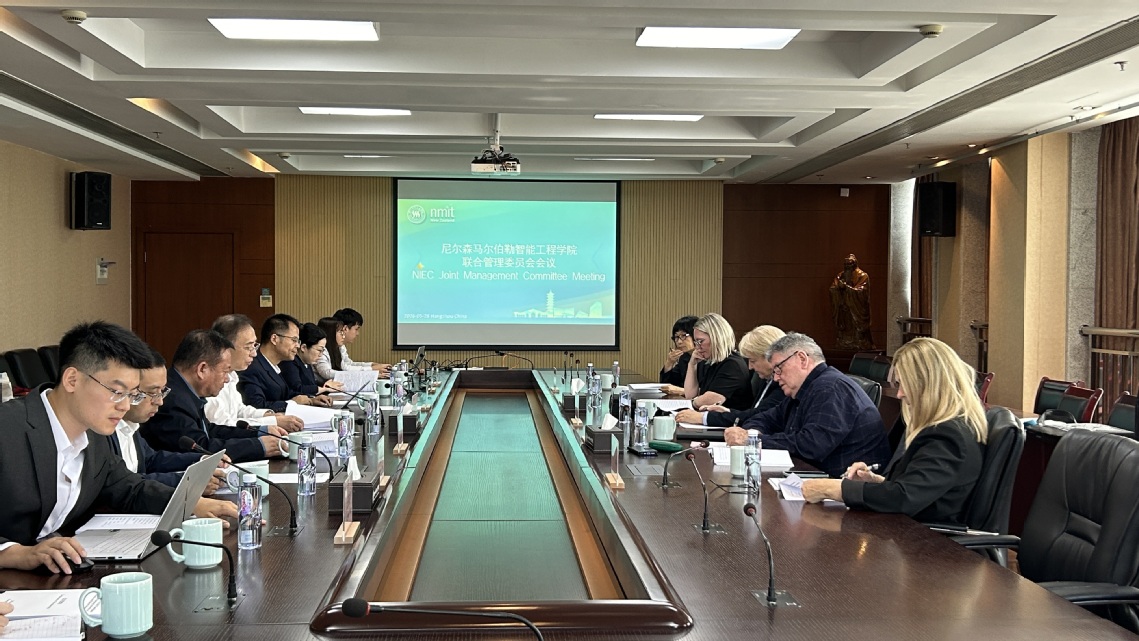

On 28 May, the first meeting of the Joint Management Committee of NMIT Intelligent Engineering of Zhejiang University of Water Resources and Electric Power was held at Zhejiang University of Water Resources and Electric power. All committee members attended the meeting, including Wan Jian, President of Zhejiang University of Water Resources and Electric power; Li Zhenghui, Vice-President; Caroline Seelig, President of the Nelson Marlborough Institute of Technology (NMIT) in New Zealand; and Kate Neame, Vice-President of NMIT.
At the meeting, President Jian Wan provided an explanatory statement on the series of regulations and rules submitted for deliberation. He pointed out that the regulatory documents submitted for deliberation strictly adhere to the relevant laws and regulations governing Sino-foreign cooperative education, as well as the agreement between the two institutions. Drawing on the proven management experience of similar domestic institutions, they have been formulated in full consideration of the School of Intelligent Engineering’s operational realities and talent development objectives, with the aim of providing a solid foundation for the School’s standardised operation and the high-quality cultivation of talent.It was also clarified at the meeting that this review constituted the first round of discussions; following the meeting, the documents would be amended and refined in accordance with the committee members’ feedback before being submitted for written confirmation and formally published. Should any provisions prove unsuitable during implementation, a revision process would be initiated promptly.
The attending committee members discussed the initial set of regulations item by item, exchanging in-depth views on specific provisions such as student registration management, examination and grading management, textbook management, and detailed rules for changing majors, and reached a consensus on the necessary revisions. Both parties agreed that the development of regulations forms the cornerstone of the standardised operation of the joint educational programme and should be continuously optimised and refined through practical application.
The successful convening of this Joint Management Committee meeting marks the School of Intelligent Engineering’s formal transition from the preparatory stage to full-scale operation. Both parties expressed their commitment to continuing to uphold the principles of openness, cooperation and mutual benefit, with the aim of establishing the School as a model platform for China-Singapore educational cooperation.